In Peterborough, the mix of shallow limestone bedrock and overlying glacial till keeps things interesting below grade. Many builders don't realize that the silty clay till common in the city's south end can lose significant strength when saturated, which is exactly why a standard penetration test alone doesn't tell the full story. When a project involves deep excavations near the Otonabee River or heavy structural loads on compressible soils, we pull undisturbed Shelby tube samples and run them through our triaxial cell to measure how the material behaves under actual confining pressure. The triaxial test gives us the drained cohesion and friction angle—parameters you can't reliably pull from index testing—and for sites with sensitive clay layers, we often pair it with an in-situ permeability test to understand how quickly pore pressures might build up during construction.
A properly executed triaxial program gives you the effective stress parameters—c' and φ'—that transform a guess about soil strength into an engineered decision.
Scope of work in Peterborough Ontario
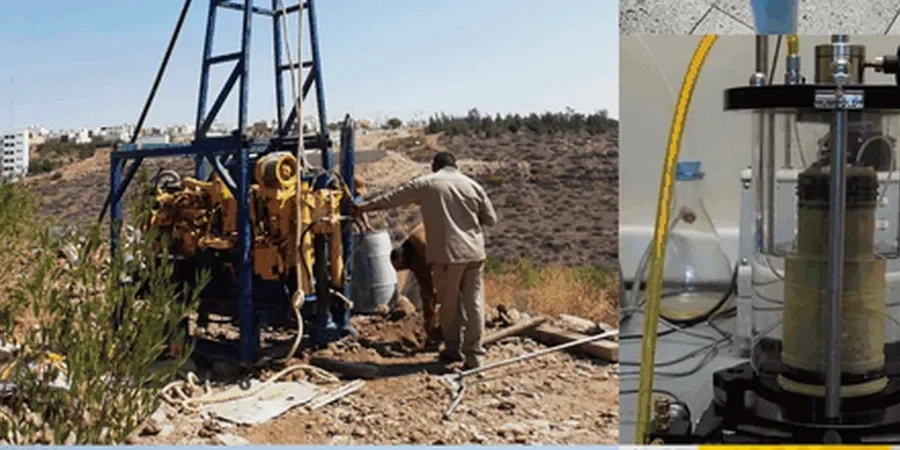
Critical ground factors in Peterborough Ontario
We see a clear split between the limestone-floored neighborhoods west of Parkhill Road and the deeper clay deposits toward Little Lake Cemetery. On the west side, a footing might bear directly on rock with minimal settlement, and a triaxial test on the weathered till becomes a verification step. Down by the lake, that same till transitions into a softer, lightly overconsolidated silty clay that has caused differential settlement in older low-rise buildings. Skipping shear strength testing in these lower areas is what leads to surprises during excavation—sidewalls that look stable at the start of the day can start creeping by late afternoon if the undrained shear strength was overestimated. The triaxial test puts a number on that risk, giving the geotechnical engineer the parameters needed to specify safe batter angles or temporary shoring loads before the dig starts.
Our services
Our Peterborough lab runs a complete geotechnical testing program, not just triaxial cells. Here's what typically gets bundled into a site investigation package:
Consolidated Undrained (CU) Triaxial Series
Three specimens sheared at different confining pressures, with pore pressure measurement. This is the standard package for determining effective stress parameters in saturated cohesive soils.
Unconsolidated Undrained (UU) Quick Shear
Faster turnaround for preliminary bearing capacity estimates, particularly useful during the feasibility stage of low-rise residential projects in Peterborough's north end.
Stress Path & Modulus Testing
Custom loading sequences for projects requiring soil stiffness at small strains or specific stress paths, often requested for numerical modeling of deep excavations.
Common questions
What's the difference between a UU and a CU triaxial test?
A UU (unconsolidated-undrained) test doesn't allow drainage at any stage, so we're measuring the undrained shear strength—useful for short-term stability of excavations in clay. A CU (consolidated-undrained) test consolidates the sample first, then shears it undrained while measuring pore pressure, giving you effective stress friction angle and cohesion. For long-term foundation design in Peterborough clays, CU is the standard because it models the soil's drained strength after construction pore pressures have dissipated.
How long does a triaxial test take from sample to report?
A CU series typically runs 7 to 10 business days from specimen trimming to final report. The consolidation stage alone can take 24 to 48 hours depending on soil permeability, and the shear stage runs at a rate of 0.01 to 0.05 mm per minute to maintain drained pore pressure conditions at the failure plane. UU tests are faster, usually 3 to 5 business days. We always confirm timelines based on the specific material and number of specimens.
What does a triaxial test cost in Peterborough?
A full CU triaxial series with three specimens and pore pressure measurement runs between CA$2,360 and CA$3,740, depending on specimen diameter, consolidation stress range, and whether remolding is required for granular materials. A single UU quick shear starts lower. We supply a firm quote once we know the Shelby tube condition, number of depth intervals, and whether you need effective stress parameters or just a quick undrained strength check.
Do you need Shelby tube samples for triaxial testing?
For cohesive soils, yes—Shelby tubes supply the undisturbed samples we need to preserve in-situ structure and moisture content. We extrude the tubes in the lab, carefully trim specimens to a 2:1 height-to-diameter ratio, and avoid any drying or disturbance. For granular soils that can't be sampled undisturbed, we reconstruct specimens to a target density based on SPT blow counts and grain size data, but these reconstituted tests carry a caveat about representative structure in the report.
Can triaxial data be used for slope stability analysis?
Absolutely. The effective stress friction angle and cohesion from a CU series feed directly into limit equilibrium slope models. For Peterborough sites along the Otonabee River or the Trent-Severn Waterway, where water level fluctuation influences pore pressure, drained parameters from triaxial testing are essential for calculating a reliable factor of safety. We've seen slope designs that looked stable under total stress assumptions fail to meet the minimum FOS once effective stress parameters were applied.