Peterborough’s industrial legacy, from the Quaker Oats plant to the Canadian General Electric complex, was built on a geological patchwork that still challenges every new foundation poured today. The city sits atop a transition zone where shallow Paleozoic limestone bedrock gives way to deep glacial deposits, creating unpredictable bearing conditions within a single site. Our laboratory team runs the CPT test continuously across these transitions because the cone’s real-time tip resistance and sleeve friction data catch the exact depth where competent rock ends and soft clay begins.
For projects along the Otonabee River floodplain or in the Jackson Creek valley, we often pair the CPT test with grain size analysis to confirm the silt content in alluvial layers that affect liquefaction potential under the 1-in-2,475-year seismic event mandated by the NBCC for eastern Ontario. The 20-tonne penetration rig handles the dense till caps common in the north end subdivisions without pre-drilling, saving contractors a day of site prep on tight schedules.
Twenty tonnes of push force through Peterborough till — one continuous log from gravel cap to limestone refusal, no gaps, no sample disturbance.
Scope of work in Peterborough Ontario
A typical Peterborough CPT sounding reaches refusal on the Gull River Formation limestone at 8 to 22 metres depth, but in the former river channels we have pushed beyond 35 metres through soft organic silts without losing the shear wave velocity trace from the seismic cone module. This seismic CPT variant, referenced in CSA A23.3 for site class determination, eliminates the separate MASW survey on tight urban lots where the concrete pad at the Fleming College campus expansion left no room for a geophone spread.
Critical ground factors in Peterborough Ontario
The NBCC 2020 places Peterborough in a zone of moderate seismic hazard (Sa(0.2) ≈ 0.25–0.35g on Site Class C), but the real risk multiplier is the city’s Site Class E soils — the thick, soft to firm glaciolacustrine clays that amplify ground motion by a factor of two or more compared to the reference rock condition. A standard borehole program that ends at 15 metres without measuring shear wave velocity may classify these clays as Site Class D, underestimating spectral accelerations and leaving a structural weak link in the lateral system. Cone penetration testing with the seismic module resolves this ambiguity definitively: the Vs profile from surface to refusal is the direct input for liquefaction assessment using the CPT-based Boulanger & Idriss (2014) triggering procedure, which the Ontario Building Code now accepts as an alternative to SPT-based methods when supported by thin-walled piston sampling at key horizons.
Our services
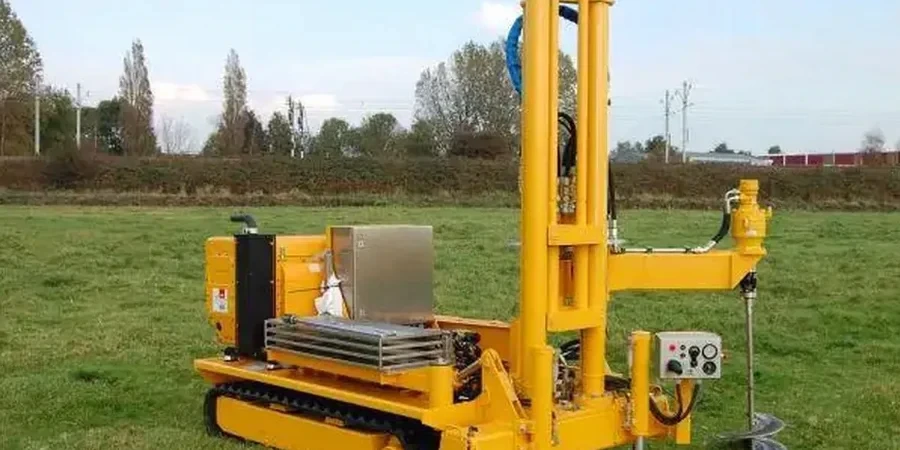
Our Peterborough CPT unit is a fully instrumented 20-tonne truck-mounted rig with real-time data acquisition and dissipation testing capability. Every sounding is processed through proprietary filtering to remove noisy overburden corrections, delivering clean qc and Rf logs the same day as the field work.
Piezocone (CPTu) Sounding
Continuous cone with pore pressure measurement behind the tip. Essential for detecting thin clay seams in the Peterborough till that control drainage and consolidation rate under footing loads.
Seismic Cone (SCPTu) Add-On
Downhole shear wave velocity measurement during the same push, eliminating a separate geophysical crew. Direct NBCC Site Class determination from the Vs30 profile, critical for mid-rise structures on the varved clays south of Lansdowne.
Dissipation Test & Consolidation Analysis
Monotonic pore pressure decay recorded at selected clay horizons. Outputs coefficient of consolidation (ch) for time-rate settlement predictions under footings and embankment loads on the compressible alluvium of the Otonabee floodplain.
Common questions
How deep can the CPT push in Peterborough's till before refusal?
The 20-tonne rig typically reaches refusal on the Gull River Formation limestone between 8 and 22 metres depth, depending on the till thickness and cobble content. In the deeper paleochannels south of the city, we have pushed beyond 35 metres through soft organic silts without hitting refusal. If bedrock refusal is shallower than expected, the cone data still provides a complete profile of the overburden — no wasted borehole.
What does a CPT test cost in the Peterborough area?
A single CPT sounding in Peterborough runs between CA$240 and CA$320, depending on total depth, whether the seismic module is active, and the number of dissipation tests requested. Deep pushes over 25 metres or sites requiring the seismic cone add-on fall at the upper end of the range. The price includes real-time data processing and a same-day log in digital format.
Can CPT replace a borehole for foundation design under the Ontario Building Code?
Yes, with a caveat: the CPT provides continuous qc, fs, and u2 data that engineers can use directly for bearing capacity and settlement calculations, and the SCPTu variant delivers the shear wave velocity profile required for NBCC Site Class determination. However, the Code still requires physical samples for index testing when correlating cone parameters to undrained shear strength in sensitive clays. We typically recommend one calibration borehole per site paired with multiple CPT soundings to satisfy both the continuous profiling and sampling requirements efficiently.