Peterborough's expansion from a lumber town into a regional hub has pushed construction deeper into the drumlin fields and the limestone plains bordering the Otonabee River. The city sits at roughly 44.3048°N, where the topography tells a clear story of glacial retreat: sandy kame deposits, dense lodgement till, and fractured limestone of the Bobcaygeon Formation all lie within a few hundred meters of each other. What holds up a warehouse in the Harper Road business park often fails to drain properly for a foundation just two concessions south. Our field permeability testing using Lefranc and Lugeon methods answers the critical question that lab tests alone cannot: how fast does water actually move through these heterogeneous deposits under real field conditions? Without this data, dewatering estimates become guesswork and basement waterproofing remains a liability. For sites near the Trent-Severn Waterway where water table fluctuations are seasonal and pronounced, we often pair the Lefranc test with a CPT sounding to map the stratigraphic boundaries controlling seepage paths before finalizing excavation support designs.
In Peterborough's fractured limestone, a single Lugeon test can reveal more about foundation drainage risk than a dozen lab permeameter runs on intact core samples.
Scope of work in Peterborough Ontario
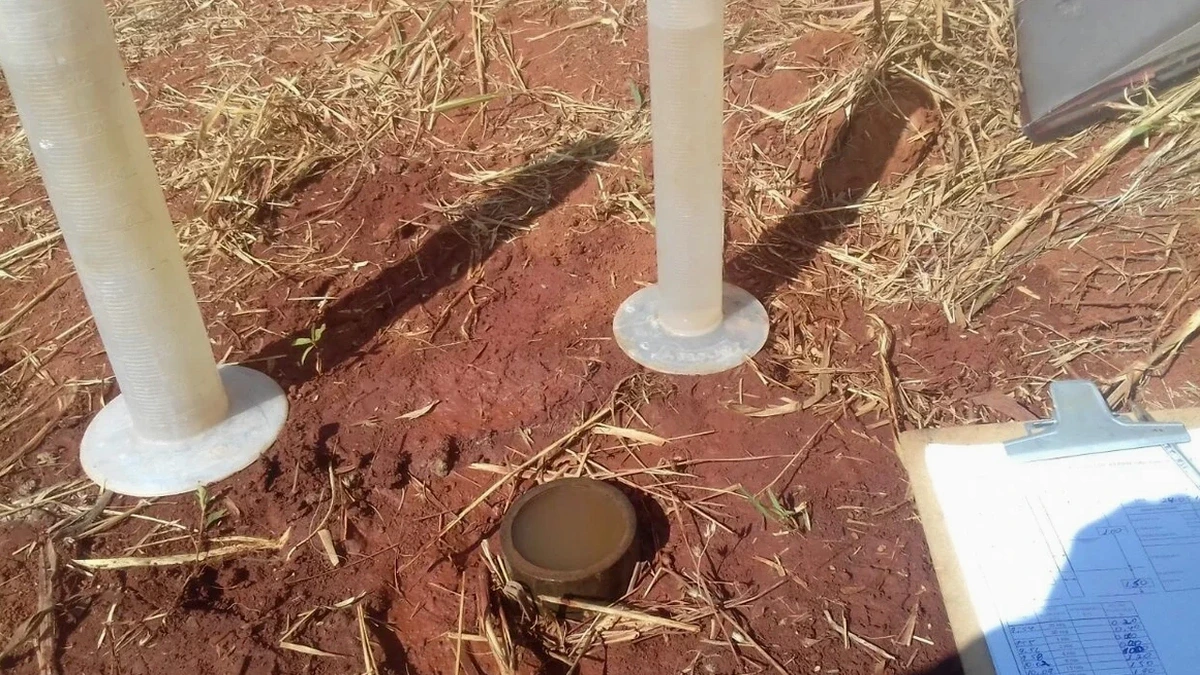
Field demonstration
Critical ground factors in Peterborough Ontario
A mid-rise residential project on Water Street ran into serious trouble when the geotechnical report relied solely on grain-size correlations to predict permeability. The excavation hit a network of open joints in the Bobcaygeon limestone at 6 meters depth, and within hours, inflows exceeded 400 liters per minute. The contractor's dewatering system, sized for assumed homogeneous soil, was overwhelmed. We mobilized a Lugeon test program the following week, isolating 3-meter intervals of the upper bedrock. The data showed hydraulic conductivity values spiking to 8x10^-5 m/s in two discrete horizons, directly corresponding to near-vertical joint sets visible in oriented core. The solution required a redesign of the foundation drain system and targeted curtain grouting. In Peterborough, where paleozoic bedrock is never far below the surface, skipping a field permeability test can easily double the cost of temporary works. The Otonabee River's influence on local groundwater gradients only amplifies this risk during spring melt and heavy autumn rains.
Our services
Our Peterborough field permeability program covers the full spectrum of in-situ hydraulic testing, from soil boreholes to deep rock packer systems. Every test is supervised by a hydrogeologist or senior technician who logs the response in real time, ensuring the steady-state criteria are genuinely met.
Lefranc Testing in Overburden
Variable and constant head tests performed in cased boreholes through the glacial till and kame deposits common across the Peterborough Drumlin Field. We isolate the screen zone with bentonite seals to eliminate vertical leakage along the casing.
Lugeon Packer Testing in Bedrock
Single and double packer configurations for testing the Paleozoic limestone sequence. Our five-stage pressure cycle identifies fracture flow regimes, hydraulic jacking thresholds, and the transition from laminar to turbulent flow.
Combined Hydrogeological Characterization
Integrated reporting that overlays permeability test results onto the geotechnical cross-section. This service directly supports dewatering design, environmental site assessments, and basement waterproofing specifications.
Common questions
What is the typical cost range for a Lefranc or Lugeon test program in Peterborough?
For a single borehole with two to three Lefranc test intervals, or a single Lugeon packer test in rock, our pricing typically falls between CA$760 and CA$1,340. The final cost depends on depth, access constraints, and the number of isolated test zones required. A multi-borehole campaign with detailed hydrogeological interpretation will be priced per meter of testing.
When is a Lugeon test required instead of a Lefranc test?
A Lugeon test is specified when the project interacts with fractured rock, typically the limestone of the Bobcaygeon or Verulam formations found at shallow depth across much of Peterborough. The packer assembly isolates a specific section of the borehole, allowing us to measure hydraulic conductivity and fracture behavior under controlled pressure steps. Lefranc tests are used in the overlying soil, such as the silty till and sand layers.
How long does a field permeability test take on site?
A single Lefranc test in soil, including drilling, casing installation, and running a variable-head test to steady-state conditions, typically takes two to three hours. A full five-cycle Lugeon test in rock, with packer setting and pressure stabilization at each step, requires approximately four to six hours per test interval. We always confirm steady flow before concluding any stage.