One of the most overlooked risks during foundation design in Peterborough is assuming the dense glacial till will not liquefy. This error can lead to catastrophic differential settlement under seismic loading. While the bedrock of the Trenton Group is relatively shallow—often within 20 to 30 feet in the downtown core—the overlying saturated sands and silts near the Otonabee River exhibit a completely different behavior. A proper soil liquefaction analysis requires more than just an SPT blow count; it demands a critical evaluation of the cyclic stress ratio using site-specific shear wave velocities. Our team integrates field data from seismic refraction profiling to map the depth to the phreatic surface accurately, then cross-references these profiles with the National Building Code of Canada (NBCC) seismic hazard values for the 2020 Peterborough region. The result is a defensible factor of safety against liquefaction, not a generic assumption.
Liquefaction susceptibility in Peterborough is not uniform; the transition from dense till to loose fluvial deposits can occur within a single building footprint.
Scope of work in Peterborough Ontario
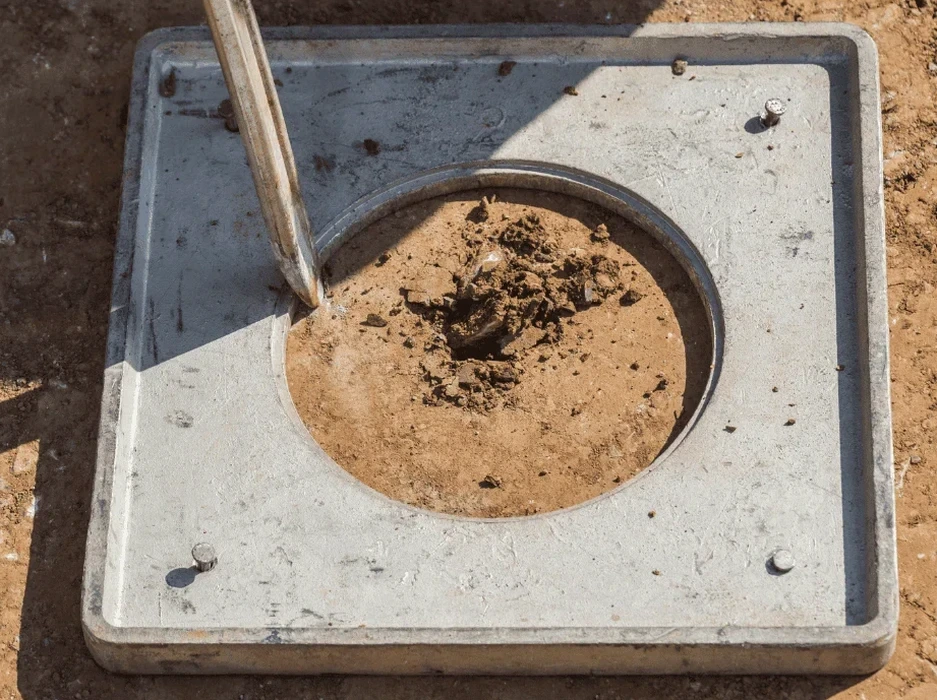
Critical ground factors in Peterborough Ontario
The contrast between the Hunter Street East area and the industrial parks near The Parkway illustrates the localized nature of liquefaction risk in the city. Hunter Street, closer to the river, sits on a higher proportion of loose Holocene alluvium with a water table that fluctuates seasonally just 1.5 meters below ground. This creates a high potential for sand boils and lateral spreading during a moderate seismic event. In contrast, the Parkway corridor rests on a thicker sequence of compacted till over the Paleozoic limestone, offering a much higher resistance to cyclic mobility. However, even in these apparently 'good' areas, isolated pockets of saturated loose silt can exist, particularly where pre-glacial valleys were infilled. Ignoring a targeted soil liquefaction analysis in the Hunter Street zone risks designing a foundation that meets static bearing capacity but fails the serviceability limit state for seismic settlement, requiring expensive post-event grouting or underpinning.
Our services
Our technical solutions in Peterborough cover the full spectrum of seismic soil assessment, from initial field exploration to advanced numerical modeling of pore pressure generation.
CPT-based cyclic assessment
We utilize cone penetration testing to supply a continuous profile of the soil behavior type index (Ic), allowing for a high-resolution evaluation of liquefaction susceptibility without sample disturbance.
Shear wave velocity profiling
Downhole and crosshole seismic methods are deployed to measure the small-strain shear modulus (Gmax), a critical input for calculating the cyclic stress ratio in the Peterborough region.
Post-liquefaction settlement analysis
We estimate the volumetric strain and consequent ground settlement using the Ishihara and Yoshimine procedure, integrating the factor of safety against liquefaction for each sub-layer.
Lateral spreading hazard mapping
For sites adjacent to the Otonabee River, we assess the potential for lateral displacement using empirical models that consider the topographic gradient and the thickness of the liquefiable layer.
Common questions
What is the typical cost for a comprehensive soil liquefaction analysis in Peterborough?
The investment for a full liquefaction assessment in the Peterborough area typically falls between CA$3,280 and CA$6,010. The final budget depends on the depth of the boreholes, the number of SPT or CPT soundings required, and the complexity of the laboratory testing program (e.g., cyclic triaxial tests). We supply a detailed proposal after reviewing the site's proximity to mapped paleochannels.
How does the shallow bedrock in Peterborough influence the liquefaction analysis?
The shallow Paleozoic bedrock often acts as a refracting boundary for seismic waves, which can amplify surface ground motions. While the bedrock itself is not susceptible, the impedance contrast can trap energy in the overlying saturated sands, increasing the cyclic stress ratio. Our analysis models this site-specific resonance effect rather than applying a simple reduction factor.
Which standard do you use to determine liquefaction potential in Ontario?
We follow the hierarchical approach outlined in the Canadian Foundation Engineering Manual, supported by the seismic provisions of the NBCC 2020. For standardized penetration testing, we adhere to ASTM D6066 to ensure the N60 values are correctly normalized for overburden pressure and hammer energy efficiency before applying the empirical liquefaction triggering curves.