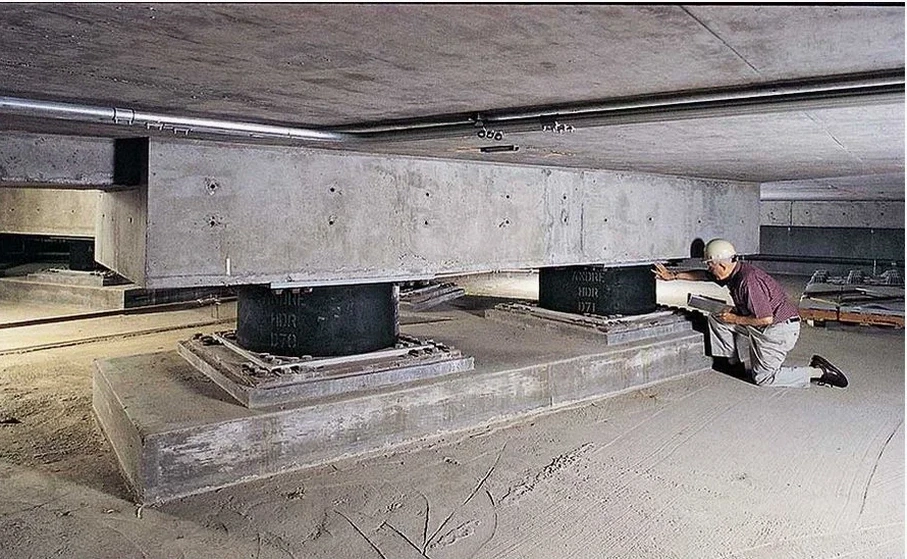
A three-storey medical building on Charlotte Street was the project that changed how we approach Peterborough’s seismic risk. The owner wanted open floor plates. The architect wanted glass. The soil report showed 2 metres of till over limestone — great bearing, but sharp impedance contrast. A fixed-base design would have amplified short-period motion right into the surgical suites. We proposed base isolation. Not because the code demanded it. Because the occupancy justified it. The isolators sit between the foundation and the superstructure. They stretch the building’s period past the dominant site frequency. Ground moves. Building doesn’t. That is the principle. Making it work on a tight urban lot with a high water table is where background counts. We have done it. We understand the NBCC 2020 seismic hazard values for the region — Sa(0.2) and Sa(1.0) — and we know how the shallow bedrock in Peterborough modifies the demand. When a fixed-base solution shows drift ratios that threaten cladding or equipment, isolation becomes a practical alternative. It is not an academic exercise. It is a buildable solution. We have seen it protect inventory in big-box retail on Lansdowne Street and keep hospital generators operational after a simulated event. The analysis is nonlinear. The hardware is tested to CSA standards. The outcome is a building that stays functional when others are being evacuated.
A base-isolated building in Peterborough doesn’t fight the earthquake — it outlasts it. Period shift is the mechanism. Functional recovery is the result.
Scope of work in Peterborough Ontario
Critical ground factors in Peterborough Ontario
Downtown Peterborough and the north-end retail corridor sit on the same limestone formation, but the risk profile differs sharply. The downtown core has older masonry buildings with brittle cladding on shallow footings. North-end big-box stores are steel frames on spread footings with high seismic mass from inventory. Both can fail in ways base isolation prevents. We saw a case on George Street where an unreinforced masonry parapet would have needed extensive anchoring under a fixed-base retrofit. Isolation reduced the demand enough to preserve the heritage fabric. Out near the Parkway corridor, where the overburden thickens slightly, the site period shifts and the isolation system must be re-tuned. We do not copy-paste isolator designs across town. Each project gets its own site-specific response spectrum from the NBCC hazard tool, adjusted for Site Class C or D. The biggest risk we see is underestimating the moat displacement during a maximum considered earthquake. Get that wrong and the building pounds against the retaining wall. We design the moat for the 975-year return period event plus an allowance for torsion and accidental eccentricity. That is not conservative. That is code minimum applied correctly. Ignoring it is what turns a protected building into a liability.
Our services
We deliver base isolation design as a complete package, from feasibility study through construction support. Every project starts with a seismic hazard assessment specific to the Peterborough site coordinates. The isolation system is then designed, peer-reviewed, and coordinated with the structural, mechanical, and architectural teams.
Feasibility Analysis
We compare fixed-base vs. isolated performance for your Peterborough project, using NBCC 2020 hazard values. We estimate isolator dimensions, moat clearances, and construction cost deltas so you can make an informed decision before schematic design locks in.
Isolator Design & Specification
Full nonlinear time-history or response-spectrum analysis. We size lead-rubber or sliding pendulum isolators, specify elastomer properties, design the wind-restraint system, and produce sealed drawings for permit submission in Ontario.
Prototype Testing Oversight
We write the testing protocol, review the test rig setup, witness the full-scale dynamic tests, and interpret the hysteresis loops. The isolators are not accepted until the force-displacement curves match our design parameters within tolerance.
Common questions
What type of building in Peterborough benefits most from base isolation?
Buildings where post-earthquake functionality matters. Hospitals, emergency operations centres, data centres, laboratories with sensitive equipment, and heritage structures where conventional retrofit would be intrusive. We also recommend it for essential facilities designated as post-disaster shelters under the Ontario Building Code. If your building must remain operational after the design earthquake, isolation is often the most direct path to that performance objective.
Does shallow bedrock in Peterborough make isolation harder to design?
It changes the design, not complicates it unnecessarily. Shallow rock produces a short-period site response. That actually increases the spectral acceleration in the fixed-base period range, which strengthens the case for isolation. The isolator period must be long enough to clear the amplified region. We typically target 2.5 seconds or higher. The moat and foundation detailing require care because the rock is near the surface, but the concept works well on these sites.
What does base isolation design cost for a project in Peterborough?
For a typical low to mid-rise building in the Peterborough area, base isolation design fees range from CA$5,060 to CA$12,720 depending on the structural complexity, number of isolators, and whether nonlinear time-history analysis is required. Prototype testing costs are separate and depend on the isolator program. We supply a fixed-fee proposal after reviewing the architectural plans and geotechnical report.
Can base isolation be added to an existing building in downtown Peterborough?
Yes, but it is a significant structural intervention. The building must be temporarily supported while the isolation plane is cut in and bearings are installed. We have done it for heritage masonry buildings where conventional strengthening would have damaged the historic fabric. The feasibility depends on the existing foundation type, column layout, and access around the perimeter. A detailed structural survey and geotechnical investigation are the first steps. More info.