With over 80,000 residents, Peterborough sits at an elevation of roughly 200 meters above sea level, where glaciolacustrine silts and sandy tills define the subsurface. Each year, hundreds of residential slabs, commercial pads, and arterial roadways are placed on engineered fill that must meet strict compaction specifications. When the local building department asks for density verification, the sand cone method becomes our primary tool. We run these tests daily across the city—from new subdivisions near Trent University to utility trench reinstatements along Lansdowne Street—because a failing test means rework, and rework costs the contractor real money. The test itself is deceptively simple, but executing it properly on Peterborough’s moisture-sensitive silts demands background with the material’s behavior under compaction effort and a solid understanding of ASTM D1556 procedure.
A compaction test that doesn’t account for oversized particles in Peterborough’s stony till can over-report density by two to three percent—enough to mask a failing lift.
Scope of work in Peterborough Ontario
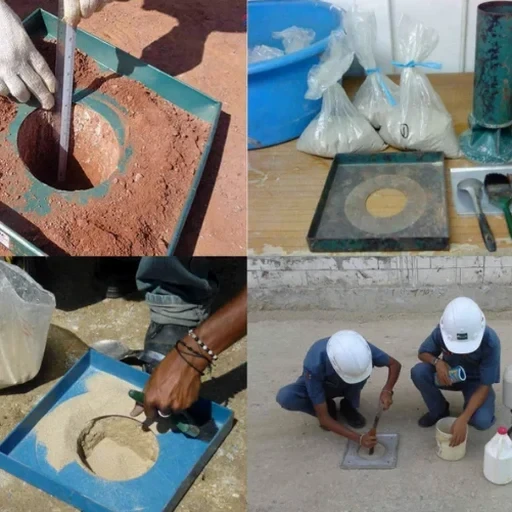
Field demonstration
Critical ground factors in Peterborough Ontario
Peterborough’s expansion through the post-war decades placed entire neighborhoods on compacted fill derived from glacial till, a material that can vary from clayey silt to sandy gravel within a single block. When a contractor skips verification testing and relies solely on roller passes, hidden defects emerge months later as differential settlement beneath footings or longitudinal cracking in asphalt pavement. The plate load test provides modulus data that helps correlate stiffness with density, but the sand cone remains the direct reference for compaction acceptance under OPSS 501. On sites near the Otonabee River where groundwater sits within two meters of grade, we have measured density drops of over five percent when backfill moisture exceeds optimum by just a few points—a scenario that triggers costly removal and recompaction if not caught early. The city’s building solutions division increasingly requires third-party density reports before issuing occupancy permits, making independent verification a practical necessity rather than a discretionary extra.
Our services
Our Peterborough compaction testing program covers the full chain from laboratory Proctor curves to field density verification, with reporting formats accepted by municipal inspectors and consulting engineers province-wide.
Standard Proctor (ASTM D698) and Modified Proctor (ASTM D1557)
Laboratory compaction curves developed on representative bulk samples collected from the project site, providing the maximum dry density and optimum moisture content against which field density is measured.
In-Place Density by Sand Cone (ASTM D1556)
Direct volumetric measurement of compacted fill, subgrade, or trench backfill using calibrated Ottawa sand, with immediate calculation of wet density, dry density, and percent compaction relative to the lab Proctor target.
Nuclear Gauge Correlation and Verification
Side-by-side testing with nuclear density gauges to build site-specific correlation curves, allowing faster production testing once the sand cone has validated the gauge calibration on Peterborough’s local till.
Compaction Inspection and Reporting
Full-time field technicians who document lift thickness, roller type, number of passes, and test locations on construction plans, delivering stamped PDF reports within 24 hours for contractor and consultant review.
Common questions
What does a field density test cost in Peterborough, and what affects the price?
For a standard sand cone test with a companion laboratory Proctor curve, budget between CA$160 and CA$190 per test location. The unit rate depends on the number of tests per day—mobilization costs spread thinner across a larger batch—and on whether we need to run both Standard and Modified Proctor curves for the same material. Remote sites at the north end of the county may carry a modest travel surcharge.
How many sand cone tests does the City of Peterborough require for a residential foundation backfill?
The city typically follows OPSS 501 guidelines, which call for a minimum of one density test per lift per 500 square metres of fill area, with at least one test per day of placement. For a typical single-family home with foundation backfill placed in eight-inch lifts, this usually works out to four to six tests distributed around the perimeter. The building inspector may request additional testing if visual observations suggest inadequate compaction.
Can the sand cone test be used when the fill contains gravel and cobbles, like the till found across Peterborough?
Yes, with a recognized limitation. ASTM D1556 is valid when no more than about 15% of the material is retained on the three-quarter-inch sieve. When cobbles exceed that threshold, we apply a rock correction per ASTM D4718 to adjust the laboratory Proctor curve, subtracting the volume and weight of oversized particles. For fills with extreme cobble content, we recommend pairing the sand cone with a test pit inspection to visually assess the matrix and consider a specification based on method compaction rather than end-product density.