The National Building Code of Canada (NBCC) establishes clear requirements for subsurface investigation, and in Peterborough, those requirements intersect with a distinctive geological setting. The city sits on a shallow bedrock foundation of Paleozoic limestone, overlain by glacial till and localized organic deposits that vary dramatically within short distances. A test pit excavation provides direct visual access to these strata, allowing the geotechnical team to observe soil structure, measure the depth of competent rock, and identify potential lenses of compressible material that could compromise a footing design. For projects near the Otonabee River, where alluvial silts extend several meters, the in-situ permeability testing conducted within the pit walls yields data that boreholes alone cannot capture. The Ontario Building Code supplements the NBCC with additional prescriptive measures, and our logging protocols align with both frameworks to ensure the local building department receives defensible field documentation. In a city where frost penetration reaches 1.2 meters, understanding the upper soil profile through direct excavation becomes not just prudent but essential for durable construction.
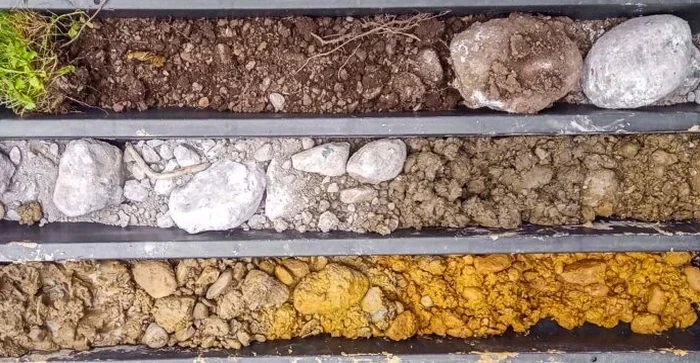
Direct visual inspection of the soil profile through a test pit reveals stratigraphic details that no indirect method can match, especially where limestone bedrock is shallow and variable.
Scope of work in Peterborough Ontario
Critical ground factors in Peterborough Ontario
Peterborough's industrial legacy along the former Canadian General Electric corridor and the historic lift lock district introduced pockets of uncontrolled fill that city records do not always capture. Early 20th-century development often leveled the terrain using ash, slag, and mixed debris, materials that today exhibit erratic settlement behavior and potential chemical reactivity with concrete. A test pit that exposes this fill allows the engineer to measure its thickness directly and recommend either removal or a deep foundation solution bypassing the problematic layer. The shallow bedrock that benefits much of the city also creates a risk of differential settlement where foundations transition abruptly from rock-bearing to soil-bearing conditions within the footprint of a single structure. Without the visual confirmation that a pit provides, these transitions can go undetected until cracks appear in the superstructure. Ontario Regulation 213/91 governs trench safety, and every excavation deeper than 1.2 meters requires a documented slope or shoring design, a requirement we integrate into the site-specific safety plan before breaking ground.
Our services
Our Peterborough test pit investigations are structured to deliver the specific subsurface information required for foundation design and regulatory approval. Each program includes detailed field logging, photographic documentation, and a signed report with recommendations.
Stratigraphic Logging and Sampling
We expose, clean, and log each soil horizon within the test pit according to the modified Unified Soil Classification System, recording bedding orientation, fracture patterns in the limestone, and any evidence of groundwater seepage. Bulk and block samples are collected for laboratory index testing.
Bearing Capacity Verification
For shallow foundation design, we perform hand vane shear tests on cohesive strata and pocket penetrometer readings on exposed bearing surfaces within the pit. Where rock is encountered, we assess rock quality designation and discontinuity spacing visible in the excavation walls.
Fill and Backfill Assessment
In areas of known or suspected historical fill, the test pit provides the only reliable method to determine fill composition, thickness, and compaction state. We document debris content, odor, staining, and any evidence of environmental concern for coordination with the project's environmental consultant.
Common questions
What is the typical cost range for a test pit investigation in Peterborough?
For a standard exploratory test pit program in the Peterborough area, including equipment mobilization, excavation, logging, sampling, and a factual report, the cost typically falls between CA$710 and CA$1,100 per pit, depending on depth, access constraints, and the number of samples collected for laboratory analysis.
How deep can a test pit be excavated in Peterborough's soil conditions?
With a standard backhoe, we can reach approximately 4.5 meters below grade in the glacial till that predominates across the city. Where groundwater is encountered at shallower depths, or where the limestone bedrock rises, the practical excavation depth may be less. Hand-dug pits for utility exposure are typically limited to 1.2 meters before shoring becomes mandatory under Ontario Regulation 213/91.
What information does a test pit provide that a borehole cannot?
A test pit exposes a continuous vertical face of soil, allowing direct observation of stratification, fissuring, oxidation mottling, and the true structure of the deposit. This is particularly useful for identifying thin organic layers, assessing jointing in the shallow limestone, and obtaining undisturbed block samples from zones that would be disturbed by drilling. It also permits direct measurement of infiltration rates within the pit.
Do you handle Ontario Ministry of Labour notifications for deep excavations?
Yes. Any excavation deeper than 1.2 meters in Ontario requires compliance with Regulation 213/91, including a documented trench safety plan, shoring design if vertical walls are specified, and notification procedures. Our field supervisor prepares the required documentation and ensures the excavation is secured and signed before any personnel enter.