A contractor working on a residential cut along Armour Road hit limestone at barely a metre down. The original plan called for a gravity wall with a standard footing key, but the shallow bedrock changed everything. In Peterborough, retaining wall design rarely follows a textbook script. The drumlin fields south of the city leave compact silty till that looks stable on a trench wall, yet softens dramatically after a few wet weeks. Up near the Otonabee River, you might encounter organic silts and loose alluvial deposits that demand a completely different wall section. Between the Canadian Shield outcrops to the north and the limestone plain underlying the city, every site forces a conversation between what the soils can actually hold and what the structure needs to resist. We have seen enough projects here—from modest garden retaining walls on Chemong Road to large commercial excavations near Lansdowne Place—to know that the difference between a wall that lasts and one that leans comes down to how honestly the ground is characterized before a single block gets placed. A test pit investigation through the weathered crust often reveals conditions that boreholes alone miss.
A retaining wall in Peterborough lives through minus-30-degree winters and April thaws that saturate the backfill in 48 hours—the design has to work at both extremes.
Scope of work in Peterborough Ontario
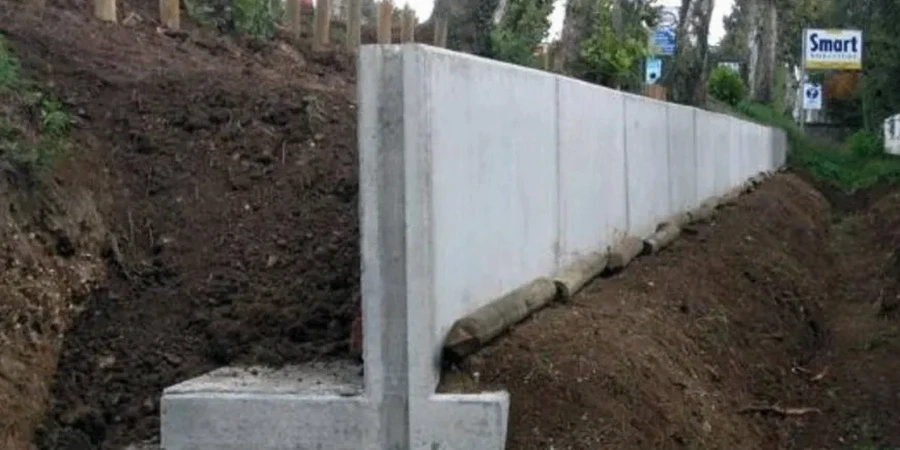
Critical ground factors in Peterborough Ontario
Section 4.2 of the Canadian Foundation Engineering Manual and NBCC Part 4 both require a geotechnical investigation for any retaining wall whose failure could endanger life or property, and in Peterborough that threshold is reached more often than owners realize. A wall built on the varved clay deposits near the Otonabee River faces a different failure mode than one keyed into the limestone of the north end: the clay can undergo progressive creep under sustained load, gradually tilting the wall over years until a wet spring triggers a sudden collapse. Frost jacking of poorly embedded footings is another local mechanism we have documented, where repeated freeze cycles lift the wall stem incrementally until the reinforcement loses bond. Designing around these risks means specifying embedment depths that reach below the active frost zone, selecting backfill materials that remain free-draining even when compacted, and verifying that the bearing stratum can handle the eccentricity introduced by lateral earth thrust. Ignoring any one of these factors in Peterborough's post-glacial landscape is not a theoretical exercise—it is a repair job waiting to happen.
Our services
Our retaining wall design service in Peterborough covers the full engineering workflow from subsurface investigation through to stamped construction drawings. Every project draws on local drilling logs and our understanding of the city's glacial stratigraphy.
Geotechnical investigation for retaining walls
Test pit logging, SPT boreholes, and laboratory testing of the till, clay, or bedrock that will support and backfill the wall.
Structural design and stability analysis
Overturning, sliding, bearing capacity, and global stability checks per CFEM and NBCC, with CSA A23.3 concrete detailing for frost durability.
Drainage and waterproofing specification
Design of granular chimney drains, filter fabric selection, weep hole spacing, and toe drain connections to manage Peterborough's spring melt volumes.
Construction review and instrumentation
Field review during excavation and backfill placement, with optional inclinometer monitoring for walls exceeding 5 metres or near sensitive structures.
Common questions
How much does retaining wall design cost for a typical Peterborough residential project?
For a standard residential retaining wall in Peterborough—say 1.2 to 2.5 metres of retained height—engineering design fees typically range from CA$1.400 to CA$6.460, depending on whether a new geotechnical investigation is required or existing soil data from the area can be referenced. Larger commercial walls or those needing anchored systems fall at the upper end or beyond.
Do I need a building permit for a retaining wall in Peterborough?
Yes, the City of Peterborough requires a building permit for retaining walls over 1.0 metre in exposed height, or any height if supporting a surcharge such as a driveway or building. The Ontario Building Code also mandates professional engineering review for walls exceeding 1.2 metres, so stamped drawings are part of the permit submission.
What is the biggest design challenge with Peterborough's glacial till?
The biggest challenge is the till's sensitivity to moisture and freeze-thaw cycling. It can stand nearly vertical during a dry summer excavation, then slough and lose strength rapidly after heavy rain or spring melt. Our designs compensate with conservative drainage assumptions, deeper embedment below frost line, and backfill specifications that prevent water from ponding behind the wall.
How long does retaining wall design and approval take?
A typical timeline runs three to five weeks from site investigation to stamped drawings ready for permit submission. If test pitting or drilling is needed, that adds a week for fieldwork and laboratory testing. Complex sites near the Otonabee River or on steep drumlin slopes may require additional slope stability analysis, extending the schedule by a couple of weeks.