Peterborough sits on a complex mix of glacial till, limestone bedrock, and the organic silts that trace the Otonabee River—topography that gets tricky fast once you start excavating. At 191 meters above sea level, the city’s frost line pushes down about 1.5 meters, and the water table in areas like East City or near Jackson Creek can sit barely a meter below grade. A standard SPT investigation often reveals N-values under 10 in the upper three meters, which points us toward a raft or mat foundation rather than isolated footings. Our team works directly with local structural engineers to size the slab thickness and reinforcement so the entire footprint acts as a single rigid unit, distributing loads across the variable bearing strata without the differential settlement you would get from discrete pads.
A properly designed raft foundation in Peterborough’s glacial clays can cut total settlement by 40-60% compared to isolated footings, simply by engaging the entire building footprint as a single structural element.
Scope of work in Peterborough Ontario
Critical ground factors in Peterborough Ontario
Peterborough’s downtown core expanded rapidly after the Trent-Severn Waterway opened in 1920, and plenty of those early commercial buildings went up on shallow strip footings that have since tilted or cracked as the underlying clay consolidated. When a developer now proposes a three- or four-storey mixed-use building on an infill lot between George and Water Streets, the geotechnical reality is that the fill layer often contains brick rubble, ash, and organic lenses that would cause intolerable differential movement under point loads. A raft foundation bridges those heterogeneities by averaging the subgrade response across the entire plan area. We also pay close attention to frost heave at the perimeter—turning the slab edge down to form a perimeter beam that reaches below the frost line is standard practice here, but we verify the insulation requirements under SB-12 of the Ontario Building Code so the thermal break does not inadvertently create a cold bridge that undermines the foundation.
Our services
Our Peterborough raft foundation scope typically includes the geotechnical investigation, the structural design of the mat, and the construction-phase QA. Below are the core deliverables.
Geotechnical investigation for raft design
SPT boreholes, test pits, and laboratory testing (consolidation, triaxial) to characterize the glacial stratigraphy and define the design soil profile for the mat foundation.
Structural design and 3D FE modeling
Slab thickness, reinforcement layout, and punching shear verification using finite element software. We coordinate the column reactions with the structural engineer of record and supply CSA A23.3-compliant shop drawings.
Construction inspection and plate load testing
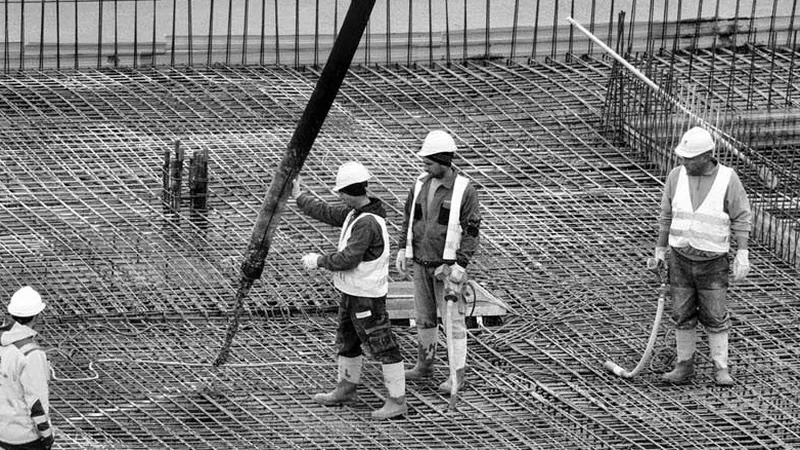
Subgrade proof-rolling, rebar placement review, concrete pour monitoring, and in-situ plate load tests on the prepared subgrade to confirm the design modulus of subgrade reaction before the raft is cast.
Common questions
What does a raft foundation design cost for a typical Peterborough residential project?
For a single-family home or townhouse block in Peterborough, the geotechnical investigation and structural design of a raft foundation generally range from CA$1,370 to CA$6,300, depending on the number of boreholes, the complexity of the soil profile, and whether 3D finite element modeling is required. A straightforward mat on competent till falls at the lower end; a floating raft over soft clay with rigid inclusions pushes toward the upper end.
When would you choose a raft foundation over strip footings in Peterborough?
We steer toward a raft when the allowable bearing pressure drops below 100 kPa, when the subgrade is highly variable over short distances (common in the river corridor), or when the total settlement under isolated footings exceeds 25 mm. It also makes sense for buildings with basement levels below the water table, where the raft acts as both foundation and permanent cut-off slab, reducing hydrostatic uplift forces through the structure's dead weight.
How do you address frost heave on a raft foundation in Ontario?
The Ontario Building Code requires foundations to bear below the frost penetration depth, which in Peterborough is set at 1.5 meters. For a raft, we achieve this by deepening the slab edge to form a perimeter beam or by installing rigid insulation (typically Type IV extruded polystyrene) horizontally around the perimeter, per SB-12. The insulation shifts the frost line outward so it does not reach frost-susceptible soil beneath the slab. We also specify free-draining granular fill under the entire raft to prevent capillary rise and ice lens formation.