Pavement design in Peterborough follows the mechanistic-empirical approach outlined in the 2020 National Building Code of Canada and CSA A23.3. The laboratory California Bearing Ratio test is the cornerstone of that methodology. Subgrade strength here is notoriously variable. The city sits on a complex mix of glacial till, limestone bedrock, and organic floodplain deposits along the Otonabee River. A standard CBR of 3% in one location can jump to 15% just 200 meters away. Our laboratory provides soaked and unsoaked CBR measurements that feed directly into pavement thickness calculations. We see this variability constantly across Peterborough projects. The test gives engineers a direct input value for structural number calculations. It is not a soil index. It is a performance parameter. For low-volume residential streets in the north end or heavy industrial access roads near the airport, the CBR value dictates whether a granular sub-base will suffice or whether a rigid pavement section becomes the only viable option.
A 4-day soaked CBR test replicates the spring-thaw conditions that degrade Peterborough’s subgrades every year, giving a conservative but realistic design value.
Scope of work in Peterborough Ontario
Critical ground factors in Peterborough Ontario
In Peterborough, we often find that contractors assume a soaked CBR of 6-8% for preliminary pavement design on silty sand sites. That assumption can be dangerously optimistic. The native glacial till in the western part of the city commonly contains pockets of laminated silt with CBR values below 3% when saturated. If the design relies on an unverified CBR, the pavement will rut within the first two spring seasons. The city’s freeze-thaw zone extends to 1.5 meters depth. Water trapped in the subgrade expands during freeze-up in January and February, then creates a saturated, weakened layer during the March thaw. A soaked CBR test replicates that exact mechanism. Skipping the soak phase or using a default CBR from a provincial table introduces a risk that no amount of asphalt thickness can correct. The subgrade fails first. The asphalt then cracks from below.
Our services
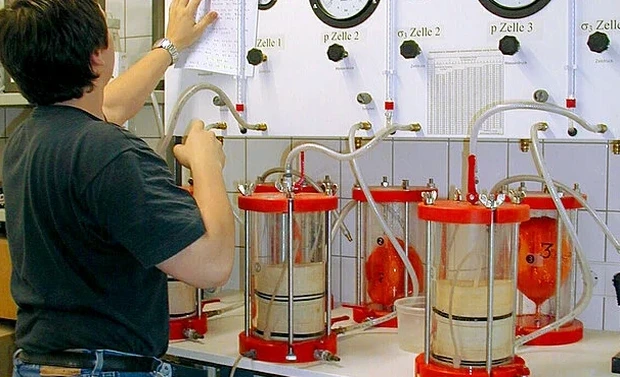
Our Peterborough laboratory CBR testing program covers the full range of subgrade preparation and pavement design support. Each service package includes compaction curve development, specimen preparation, and the 4-day soaked penetration test.
Standard Soaked CBR Test Package
Complete ASTM D1883 compliant CBR determination on a single soil sample. Includes modified Proctor compaction to establish the moisture-density relationship, specimen preparation at optimum moisture content, 96-hour soak with swell measurement, and penetration testing at 1.27 mm/min. Results reported at 2.5 mm and 5.0 mm penetration with correction for concave-up curves. Suitable for residential subdivision roads and commercial parking lot subgrades in Peterborough.
CBR vs. Moisture Content Sensitivity Study
Three-point CBR evaluation on the same soil at optimum moisture content, optimum +2%, and optimum -2%. This defines the sensitivity of subgrade strength to construction moisture control. Essential for Peterborough projects where compaction must proceed during narrow weather windows in late spring or early fall. The resulting CBR envelope allows the pavement designer to select a conservative design value based on achievable field conditions rather than idealized laboratory compaction.
Common questions
What is the difference between a soaked CBR and an unsoaked CBR, and which one should I specify for a Peterborough project?
An unsoaked CBR measures the soil’s strength at the as-compacted moisture content. A soaked CBR submerges the specimen in water for 96 hours under a surcharge load before testing. For Peterborough, the soaked CBR is the standard design input. The region experiences significant spring thaw saturation every year. The soaked value represents the weakest condition the subgrade will endure during its service life. An unsoaked CBR may overestimate strength by 40-60%, leading to under-designed pavement sections that fail prematurely. Municipal specifications in Peterborough and across Ontario require the soaked value unless the pavement is inside a climate-controlled building.
How much does a laboratory CBR test cost for a project in Peterborough?
A standard soaked CBR test on a single soil sample typically ranges from CA$180 to CA$320, depending on whether the compaction curve (Proctor) must also be developed from scratch or if the optimum moisture content is already known. A CBR sensitivity study covering three moisture points falls at the higher end of that range. The price includes specimen preparation, the full 96-hour soak period with swell monitoring, penetration testing, data analysis, and a signed report.
What soil types in the Peterborough area typically produce the lowest CBR values?
The organic silts and clayey silts found in the Otonabee River floodplain and in low-lying areas near Little Lake consistently produce the lowest CBR values, often between 1.5% and 3% when soaked. Glacial Lake Peterborough deposits, which are widespread in the city, contain laminated silts that can drop below 2% CBR when saturated. The glacial till on the higher ground west of the city is generally stronger, yielding soaked CBRs of 8% to 15%. Fill materials in older industrial areas near the downtown core are unpredictable and should always be tested rather than assigned a presumptive value.
How long does a laboratory CBR test take from sample delivery to report?
The minimum turnaround is five business days. The compaction curve requires one day. Specimen preparation and setup takes a second day. The 96-hour soak period consumes four full days. Penetration testing and data reduction occur on the fifth day. Expedited testing is not possible because the soak duration is fixed by ASTM D1883. We recommend submitting samples at least two weeks before the pavement design submittal deadline to allow for any re-testing if results are anomalous or if the soil classification requires a different compaction energy level.