Pile foundation design in Peterborough, Ontario, requires strict adherence to the National Building Code of Canada (NBCC) and CSA A23.3. The city sits atop a complex stratigraphy of Paleozoic limestone bedrock overburdened by dense glacial till and silty clay deposits. This geological setting demands deep foundations that bypass weak surficial soils. We focus on end-bearing piles socketed into competent limestone to manage structural loads effectively. The interaction between the steel or concrete pile and the fractured bedrock requires rigorous geotechnical analysis. Our approach integrates site-specific soil parameters with structural loading to deliver a foundation system that performs reliably across Peterborough’s freeze-thaw cycles. Before finalizing the pile type, we often recommend a CPT test to profile the overburden consistency or an SPT drilling program to assess bedrock refusal depth across the site.
A properly designed rock socket in Peterborough limestone transfers structural loads efficiently, but the socket length must be verified by core recovery—never assumed from regional maps alone.
Scope of work in Peterborough Ontario
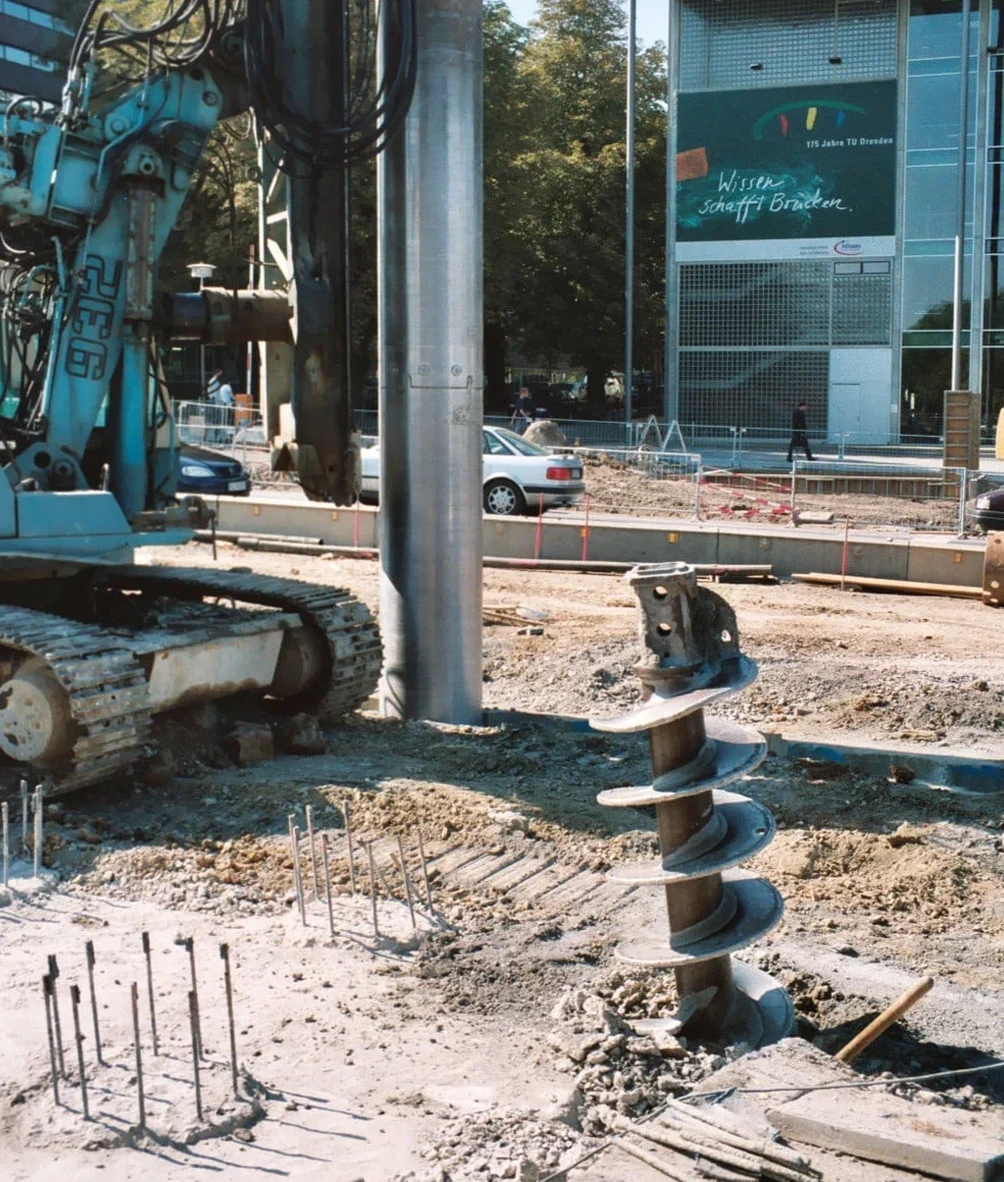
Critical ground factors in Peterborough Ontario
In Peterborough, one critical risk we see repeatedly is karstic dissolution within the limestone. A pile driven to a nominal refusal might be bearing on a thin rock bridge over a void. We mitigate this by requiring probe drilling ahead of socket excavation on high-risk sites. Another issue is the aggressive sulfate environment in some local groundwater. This attacks conventional Portland cement concrete. We specify Type HS (high sulfate-resistant) cement for cast-in-place piles in affected zones. Ignoring the lateral squeeze of the thick silty clay layers on deep pile shafts leads to unforeseen bending moments. Our designs include P-y analysis to model this soil-structure interaction precisely. We also account for downdrag if the site has recent fill, ensuring the pile does not settle under negative skin friction before the structural load is applied.
Our services
Our geotechnical team provides a complete design package for deep foundations in Peterborough. We manage the process from initial subsurface investigation through to construction inspection and pile integrity testing.
Axial Capacity Analysis
Static analysis using CFEM methods calibrated with local load test data and rock core strength results.
Lateral Load Design
P-y curve generation for glacial till and weathered rock zones to determine pile head deflection and bending moments.
Pile Load Testing
Design and supervision of static compression and tension load tests per ASTM D1143 and D3689 to validate design assumptions.
Construction Inspection
Full-time monitoring of pile installation, rock socket verification, and concrete placement to ensure specification compliance.
Common questions
How deep do piles need to go in Peterborough to reach competent bedrock?
Depth to competent limestone varies significantly. In the city center, rock is often within 5 meters. In the south end and near the river, it can be 12 to 15 meters deep. We determine the exact socket elevation based on core recovery and RQD. A minimum 1.5-meter socket into sound rock is typical, but we extend it deeper if the rock is fractured or weathered.
What is the typical cost range for a pile foundation design in Peterborough?
The engineering design fee ranges from CA$2,540 to CA$9,370 depending on the structural load complexity, number of piles, and whether load testing is required. This covers the geotechnical analysis, report, and construction specifications. It does not include the piling contractor’s installation costs.
Do you consider frost heave in pile design for Peterborough’s climate?
Yes. Frost penetration in Peterborough can reach 1.5 meters. We design the pile cap and upper shaft to resist uplift forces from frost heave in the active layer. The pile is embedded well below the frost depth. We also specify non-frost-susceptible backfill around the upper pile section to minimize adhesion forces.