Working in the Peterborough area means you quickly learn that the blanket of glacial till overlying the limestone bedrock doesn't behave uniformly across the city. From the drumlin fields near Trent University to the alluvial deposits along the Otonabee River corridor, the load-bearing story changes in ways that standard presumptive bearing values simply miss. We frequently review projects where a developer assumed consistent conditions across a site, only to encounter a buried esker deposit or a pocket of soft Lake Iroquois silty clay that required a fundamental redesign of the footing system. A formal soil mechanics study cuts through that uncertainty by quantifying strength parameters, compressibility, and drainage characteristics specific to your parcel, providing the data needed to align your structural loads with what the ground can reliably carry under the National Building Code of Canada.
Uniform glacial till across Peterborough is a myth: the Dummer Moraine in the north end behaves fundamentally differently from the Lake Iroquois clays south of Lansdowne.
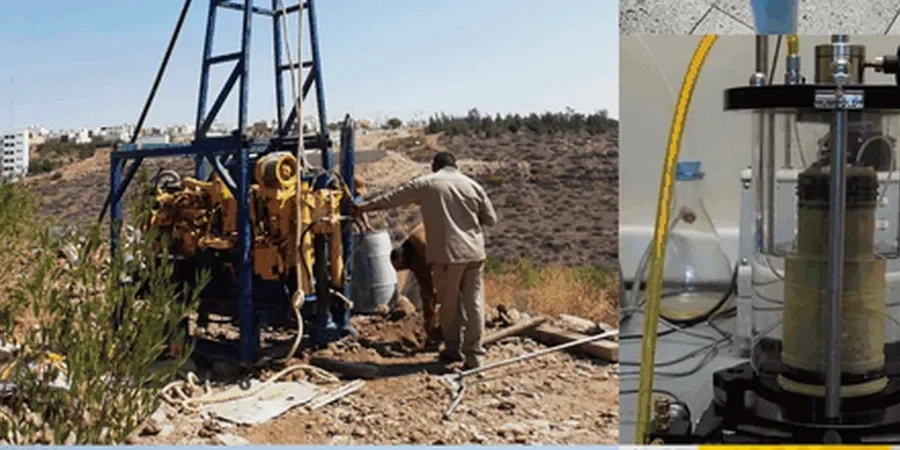
Scope of work in Peterborough Ontario
Critical ground factors in Peterborough Ontario
A mid-rise residential project on Water Street a few years back started excavation and uncovered a lens of organic silt at the depth where the tower crane pad was planned. The original report had relied on widely spaced boreholes that missed the feature entirely. The resulting redesign pushed the schedule by six weeks and required importing engineered fill to replace the compressible material. Peterborough's depositional history, with its patchwork of kame terraces, abandoned river channels, and post-glacial lake beds, creates exactly this type of hazard. A comprehensive soil mechanics study that combines adequate borehole density with targeted laboratory testing identifies these soft inclusions before they become a change order. We also evaluate seasonal groundwater fluctuation, which in the clay-rich soils near Little Lake can reduce effective stress and alter bearing capacity between spring thaw and late-summer conditions.
Our services
Our soil mechanics studies in Peterborough combine field investigation with an accredited laboratory program to deliver the design parameters your structural engineer needs. Every report includes explicit bearing resistance and settlement calculations calibrated to your foundation geometry and load configuration.
Laboratory Testing Program
Triaxial shear (CIU, CAU), one-dimensional consolidation, direct shear, and index testing on undisturbed samples recovered from the specific soil units encountered at your site. All testing follows ASTM standards and is performed in our ISO 17025 accredited facility, with results packaged into a clear geotechnical data report.
Foundation Design Parameters Report
Interpretative report that translates laboratory data into allowable bearing pressures, modulus of subgrade reaction, and estimated total and differential settlements for shallow and deep foundation alternatives. Includes liquefaction screening where applicable and recommendations for slab-on-grade support.
Common questions
What does a soil mechanics study cost for a typical residential lot in Peterborough?
For a standard single-family residential parcel in Peterborough, a soil mechanics study that includes drilling, sampling, and a targeted laboratory program generally ranges from CA$3,900 to CA$7,340. The final cost depends on the number of boreholes required, the depth of investigation, and the complexity of the laboratory testing suite needed to characterize your specific soil profile.
How many boreholes are needed, and how deep should they go?
The number and depth of boreholes depend on the size and type of structure. For a typical residential building, we usually recommend a minimum of two boreholes extending to at least 1.5 times the width of the anticipated footing influence zone, or until competent bedrock is encountered. The NBCC provides guidance on minimum investigation density, and we adjust the scope based on the variability of the subsurface conditions encountered during drilling.
How long does the laboratory testing phase add to the project timeline?
A standard laboratory program, including triaxial shear and consolidation testing, typically requires two to three weeks from the date samples arrive at our facility. Consolidation tests are the pacing item because they require incremental loading over several days to measure time-rate settlement behavior. We supply preliminary bearing recommendations within two business days after sampling if the project schedule requires an expedited path.
Can you determine if the soil on my property is susceptible to liquefaction?
Yes, we evaluate liquefaction potential as part of our soil mechanics study when the project falls within a seismic area. Peterborough sits in a region of moderate seismicity, and loose saturated sands below the water table can be susceptible. We use standard penetration test data and grain size distribution results to perform a screening analysis following the Seed and Idriss simplified procedure, which tells us whether mitigation measures need to be considered.