The drill rig sets up on a tight urban lot in downtown Peterborough, the hollow-stem auger chewing through three meters of silty clay before hitting the first ledge of limestone. You can feel the vibration change through the cab floor. That transition from overburden to bedrock is exactly what defines anchor design work in this part of Ontario. Unlike the uniform clays of the Toronto basin, Peterborough’s subsurface is a patchwork of Ordovician limestone, discontinuous till, and outwash deposits shaped by the retreat of the Kawartha Lakes ice lobe. Getting a tendon to bond reliably across that interface demands more than a generic bond length from a textbook. We pair the initial site investigation with a test pit program to log the depth to rock visually, and often combine it with an electrical resistivity survey to map fractures and voids in the limestone. That way, the anchor design—whether active for a soldier pile wall or passive for a rock slope stabilization—is grounded in the actual conditions at 44.3048° N. The Otonabee River corridor adds another variable: fluctuating groundwater levels that can reduce effective stress at the grout-soil interface, something we account for through careful corrosion protection detailing per CSA A23.3 Annex D.
In Peterborough's layered till and limestone, a successful anchor isn't about tendon capacity—it's about understanding precisely where the load transfers from steel to grout to fractured rock.
Scope of work in Peterborough Ontario
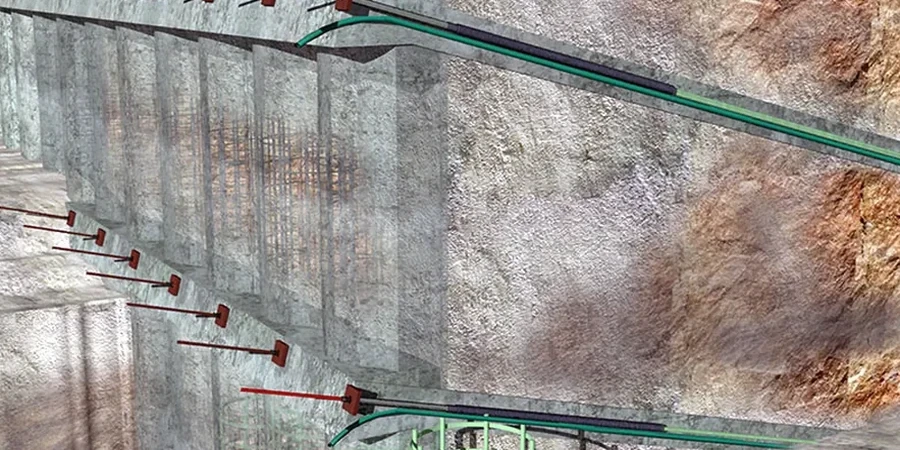
Critical ground factors in Peterborough Ontario
On a project near Jackson Park a few years back, the contractor had designed a tied-back wall assuming continuous limestone at the bond zone. The borehole log showed rock at 4.3 meters, so they figured they were safe. What the single borehole missed was a 2-meter-wide dissolution channel filled with soft clay running diagonally across the anchor alignment—a remnant of an ancient groundwater conduit in the limestone. The first three anchors failed proof testing at less than 60% of the design load. This is a risk we see repeatedly in Peterborough: interpreting a single borehole as representative of the entire site. The limestone here is not a monolithic slab; it's a paleokarst landscape buried under glacial sediment. Even within a single anchor row, the rock surface can undulate by more than a meter. We mitigate this by specifying pre-production investigation holes at every anchor location on critical structures, or by using a CPT sounding grid to interpolate the rock surface profile. Another regional concern is the seasonal fluctuation of the Otonabee aquifer, which can shift the phreatic surface by 1.5 meters between spring melt and late-summer low flow. Uplift pressures on anchored slabs and buoyancy effects on the grout column need to be checked for both extremes.
Our services
Anchor design in Peterborough extends beyond the tendon calculation. The service package covers the full lifecycle: from geotechnical investigation through to long-term monitoring, tailored to the specific demands of the local geology and regulatory environment.
Active Tieback Anchor Design for Deep Excavations
For soldier pile and lagging walls, secant pile walls, or diaphragm walls in Peterborough's urban core. We design high-capacity active anchors (up to 1,200 kN working load) with staged stressing sequences, accounting for the stiff till over rock profile. Deliverables include anchor layout drawings, bond length calculations per CSA A23.3, corrosion protection schedules, and proof testing specifications. We also supply lock-off load recommendations adjusted for anticipated creep in the till layer.
Passive Rock Anchor and Soil Nail Design for Slope Stabilization
For permanent stabilization of rock cuts along Highway 7 or slope failures in the Kawartha Lakes region, we design fully grouted passive anchors and soil nail arrays. The design incorporates stereonet analysis of joint sets in the Bobcaygeon limestone, pullout capacity verification through field testing, and integration with shotcrete facing where required. Long-term monitoring plans with load cells and inclinometers are included for critical infrastructure.
Common questions
What's the difference between active and passive anchors, and which one does my Peterborough project need?
Active anchors are stressed during installation to apply a pre-compressive force to the structure—they're the standard choice for excavation support walls where you need to control lateral deflection in real time. Passive anchors, like rock dowels or soil nails, are not stressed; they only develop resistance when the ground moves, making them better suited for long-term slope stabilization where gradual deformation is acceptable. In Peterborough, we typically recommend active systems for deep urban excavations (think downtown condos or the hospital expansion) where neighboring foundations are sensitive to movement. Passive systems work well for permanent rock slope reinforcement along highway cuts or riverbank stabilization along the Otonabee. The decision also depends on the rock mass quality: heavily fractured sections of the Verulam Formation often require active anchors to generate sufficient confinement, while competent massive limestone can perform well with passive dowels.
What permits or approvals are needed for ground anchors in Peterborough?
Within the City of Peterborough, anchored systems that extend beyond the property line—even with a temporary easement—trigger a review under the Ontario Building Code and potentially the local encroachment by-law. If the anchors pass under a public right-of-way, you'll need an encroachment permit from the city's Infrastructure and Planning solutions division. For projects near the Otonabee River, the Otonabee Region Conservation Authority (ORCA) requires a permit under Ontario Regulation 167/06 for development within the regulated floodplain or near the river's slope stability hazard area. We coordinate the submission package including anchor design drawings, proof testing procedures, and a geotechnical report demonstrating that the anchors won't compromise adjacent infrastructure. For Ministry of Transportation projects along Highway 115 or Highway 7, a separate MTO geotechnical submission is required following their ground anchor protocol.
What does anchor design and testing typically cost for a Peterborough project?
For most projects in the Peterborough area, the complete anchor design package—including site investigation review, bond length calculations, tendon selection, corrosion protection detailing, and preparation of testing specifications—ranges from CA$1,560 to CA$5,880. The cost depends on the number of anchor rows, the complexity of the stratigraphy, and whether the project requires active or passive systems. A single-tier active anchor wall with 20 anchors on a relatively straightforward till-over-limestone profile tends toward the lower end. A multi-level anchored system with variable rock surface, karst investigation requirements, and long-term corrosion monitoring falls toward the upper end. Proof testing and performance testing during installation are typically bid separately by the specialty contractor, but we supply the acceptance criteria and can supervise the testing program for an additional mobilization fee.